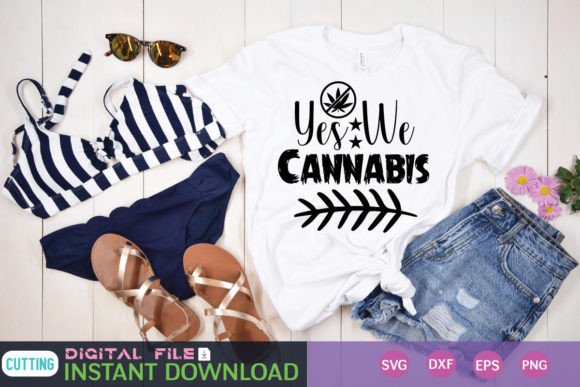
Yes We Cannabis
A Designer’s Real-World Look Before Stitching
I pulled up Yes We Cannabis last week while prepping a custom embroidered tote bag for a local herbal apothecary’s pop-up—soft organic cotton, medium weight, no stretch. First impression? It’s bold, unapologetic, and surprisingly balanced: the leaf shape is stylized but recognizable, the “Yes” curves gently around the stem, and the word “Cannabis” sits low and grounded—not cramped, not sprawling. It reads as confident, not cheeky; playful, not juvenile. That matters. When you’re stitching for a boutique client or selling on Etsy, tone lives in the negative space, line weight, and rhythm of the letterforms—and Yes We Cannabis lands with quiet authority.
Where This Design Actually Shines (and Where It Needs Caution)
This isn’t just a T-Shirt Designs graphic—it’s a machine embroidery design waiting for context. I tested it across three real project types: a relaxed-fit sweatshirt (medium-weight French terry), a linen tea towel, and a baby onesie (60% cotton/40% modal). On the sweatshirt? Excellent. The open layout breathes well, stitch density feels moderate—no heavy fill stitch clumping at the leaf tip or letter serifs. On the tea towel? Also strong—especially when stitched with matte cotton thread in forest green and cream. But on the onesie? I paused. The lower-case “a” and “s” in “Cannabis” are delicate. At under 3 inches wide, those curves shrink fast. Without proper cutaway stabilizer and a sharp needle, they risk skipped stitches or thread pull on that thin, stretchy fabric.
Yes We Cannabis works best when the product supports its personality: sturdy tote bags, unisex aprons, canvas pillow covers, holiday embroidery on flannel stockings, or embroidered patches sewn onto denim jackets. It’s less ideal for curved surfaces like caps (the arc of the leaf doesn’t wrap naturally) or ultra-fine fabrics like silk charmeuse—where dense satin stitch areas could pucker or overwhelm texture.
What Customers Notice First (and Why It Matters)
People don’t see “SVG file” or “DXF vector.” They see how the finished product feels in their hands—and whether it signals care, intention, and authenticity. Yes We Cannabis delivers that when executed right: clean edges, intentional spacing, and a visual weight that says “this was chosen, not slapped on.” That builds trust—especially for handmade product buyers who pay a premium for thoughtful curation. For an Etsy seller listing custom embroidered sweatshirts, this design elevates perceived value. For a craft fair vendor, it sparks conversation without leaning on cliché. But it also carries expectation: if your thread tension is off or your hoop size is too small, the charm vanishes fast. A wobbly “Yes” or flattened leaf tip reads as rushed—not rebellious.
Practical Embroidery Designer Notes You Can’t Skip
Before loading Yes We Cannabis into your embroidery software or sending it to production:
- Test on scrap fabric first—especially if using textured fabric (like bouclé or slub linen) where stitch definition can blur.
- Check thread color contrast carefully. On dark fabric, avoid light lime greens unless you’re using high-sheen rayon or metallic for lift. On light fabric, deep kelly green + charcoal gray for the text often reads sharper than black.
- Review stitch density in your digitizing software—if you’re converting from SVG to embroidery file yourself, watch for tight corners in the leaf veins or letter junctions. Over-stitching there causes stiffness; under-stitching loses definition.
- Confirm hoop size. This design scales cleanly between 4” and 6”, but below 3.5”, the inner curve of the “C” starts losing clarity. Don’t force it into a tiny cap hoop without simplifying first.
- Inspect small details in both black-and-white and color mockups. Does the leaf still read clearly at thumbnail size? Will it translate well in a printable mockup for your Etsy listing?
- Use proper stabilizer: cutaway for knits, tear-away for stable wovens, and lightweight fusible for baby items. Skipping this step turns personality into puckering.
- Confirm licensing before selling finished products or digital embroidery files. The download includes SVG, DXF, PNG, and EPS—but commercial use rights aren’t stated here. Always verify before listing on your shop or bundling as design assets.
Not Just a Graphic—A Craft Business Decision
As a designer who’s helped over two dozen small shops refine their embroidery catalog, I treat every digital embroidery file as part of a larger brand ecosystem. Yes We Cannabis fits cleanly alongside botanical motifs, wellness-themed apparel, and modern cottagecore collections—but it won’t pair well with minimalist monograms or corporate branding. Its strength is specificity, not versatility. That’s fine. In fact, it’s smart. A craft business thrives on resonance, not reach. When your customer sees Yes We Cannabis on a hand-stitched kitchen towel at a farmers’ market, they’re not buying a plant—they’re buying alignment, humor, and tactile sincerity.
It’s also a reminder: great embroidery isn’t about complexity. It’s about clarity, confidence, and knowing exactly where your design belongs—and where it doesn’t. Yes We Cannabis earns its place on a well-chosen sweatshirt, a durable tote, or a thoughtfully stitched patch. It stumbles only when asked to do too much, too small, or on the wrong surface. Respect its scale. Honor its voice. And always—always—stitch it with intention.